Agentic data management guide: AI agents for autonomous data operations

.png)
Table of Contents


TL; DR
- Put your data operations on autopilot with agentic data management, where AI agents handle ingestion, cleaning, governance, and analytics without constant human input
- Gain faster and more reliable decisions as agents detect and fix issues in real time, continuously improving data quality and ensuring compliance across systems
- Free your data teams to focus on strategy and innovation instead of manual troubleshooting, while automation reduces costs and scales effortlessly as your business grows
- Build on a strong, open, and secure foundation with 5X—a cloud-agnostic, open-source platform that eliminates vendor lock-in and simplifies deployment
Month end. The bookings dashboard slips three points. A core pipeline stalls on a late S3 batch. A partner adds two columns without notice. A new retention rule goes live at midnight. Slack lights up. Engineers stop feature work and start hunting the null that broke yesterday’s run.
Now replay that night with agentic operations in place. An agent detects the schema drift as the file lands and updates the mapping. Another reconciles late files and backfills the hour. Quality checks quarantine outliers before they leak downstream. Lineage refreshes in the catalog so everyone sees the change.
By morning, the dashboard is clean and the audit trail is clear.
This post shows how to build toward that state. You will start with one workflow that matters. You will measure impact in hours saved and incidents avoided. You will add guardrails so access stays least privilege and changes stay visible. Then you will scale with confidence, using 5X as the open, cloud-agnostic foundation that keeps control, cost, and speed in balance.
What is agentic data management?
Agentic data management (ADM) is an innovative approach to running your data ecosystem using intelligent, autonomous software agents. In plain terms, it means AI “agents” take over many of the tasks that human data engineers, analysts, and stewards typically do.
These agents aren’t robots in a server room – they’re programs powered by AI and machine learning that can make decisions, learn from patterns, and act on your data with minimal hand-holding.
Think of ADM as the next evolution of master data management (MDM). Traditional MDM relies on static rules and plenty of manual oversight – you set data standards and hope everyone follows them, and you manually resolve issues when they inevitably arise.
Agentic MDM/DM, by contrast, introduces context-aware automation and continuous feedback loops into data management. The AI agents constantly watch over your data: if they spot missing values or duplicate records, they can correct them.
Also read: Automated Data Management Guide: Definition, Use Cases, and Why It Matters for Your Business?
Why agentic data management is important for your business
Data is the lifeblood of decision-making and AI initiatives. Yet most businesses are struggling with the basics: siloed systems, inconsistent data, and slow, error-prone processes. This is where agentic data management becomes a game-changer. It addresses several critical pain points that traditional data management can’t: scalability, speed, and trust.
1 AI depends on quality and scalable data
As organizations scale, the volume and variety of data can overwhelm manual processes. Traditional frameworks often break under rapidly changing data environments.
Autonomous agents, however, don’t get tired or confused by big data; they can monitor thousands of data streams or tables continuously. For example, if your company doubles its data sources next year, an ADM system can adapt to new formats and standards on the fly.
2 Real-time response drives better decisions
In business, timing is everything. Traditional data management often leaves you looking in the rear-view mirror. By the time a report is compiled or a data error is found, opportunities are lost.
Agentic systems are proactive and real-time. They can flag a data quality issue or schema change the moment it occurs and either fix it or alert your team immediately.
3 Continuous quality builds data trust
Poor data quality has a massive cost with 64% of data and analytics professionals citing data quality as their top challenge impacting data integrity. For instance, agents can automatically deduplicate records, fill in missing metadata, or enforce data type standards across.
They also maintain data lineage and governance – keeping track of where data came from and how it’s transformed, which builds trust with both internal stakeholders and regulatorsdomo.com. When an AI agent is watching every dataset like a hawk, you’re far less likely to make decisions on faulty data.
Also read: Data Quality Framework: Definition, Benefits, and Implementation
4 Automation frees teams for high-value work
Lastly, agentic data management is important because it liberates your human talent. Instead of your expensive data engineers spending days on routine ETL fixes or schema updates, they can focus on strategic projects and innovation. Your analysts can spend more time extracting insights than wrangling spreadsheets. This not only boosts productivity but also helps attract and retain data professionals (nobody loves doing tedious cleanup all day).
Benefits of using agentic AI for data management
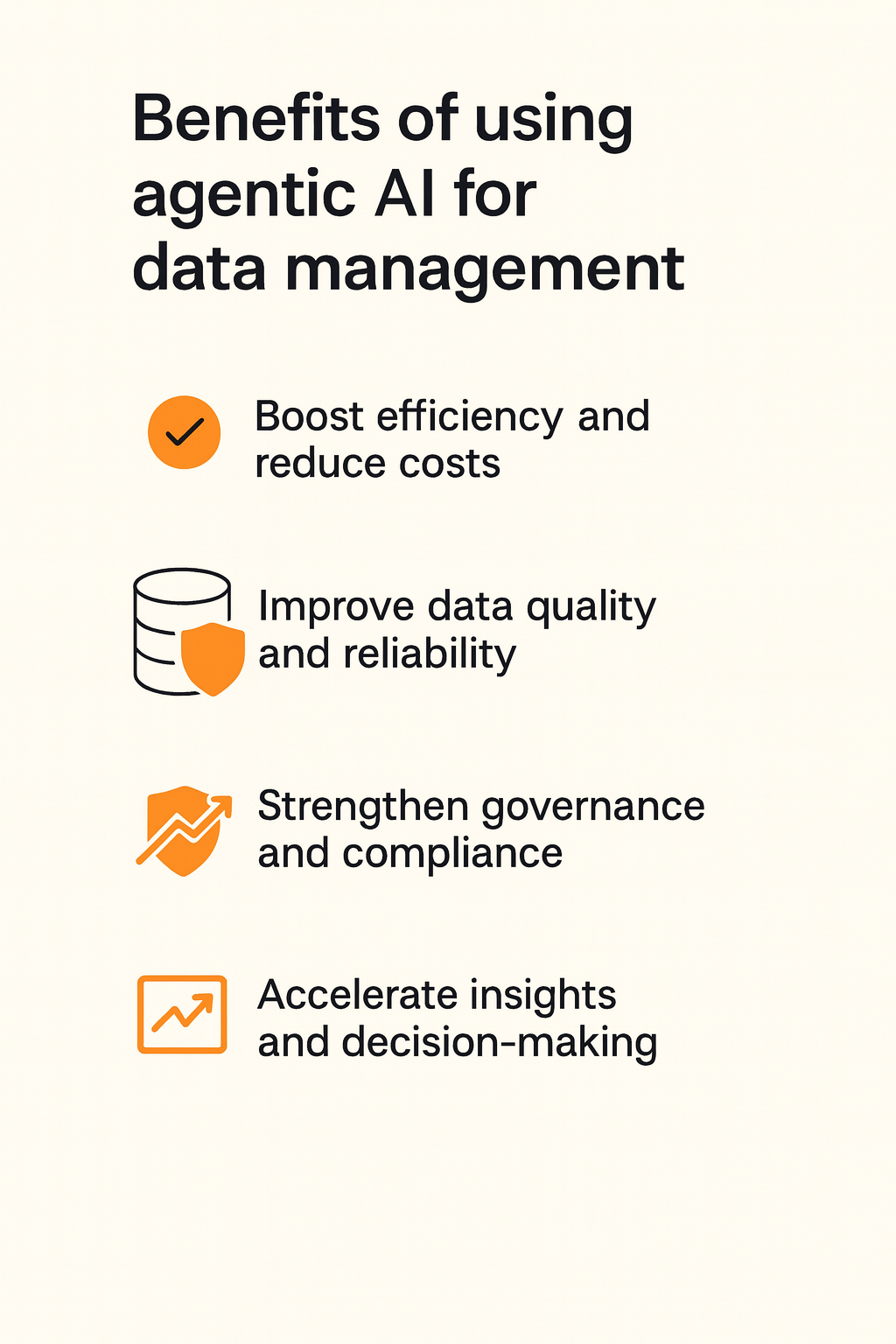
Adopting agentic data management brings a host of tangible benefits. Here are some of the biggest payoffs businesses are seeing with AI agents in their data stack:
1 Boost efficiency and reduce costs
By automating manual data tasks, ADM dramatically reduces the human effort needed day-to-day. Routine jobs like validating data entries, correcting errors, or updating schema mappings happen automatically. This frees your team to focus on higher-value work and cuts labor costs.
It also optimizes resource usage. AI agents can intelligently route workloads to avoid idle compute or clean up storage bloat. The bottom line: you do more with less.
Also read: Building Agentic AI: Definition, Features, Benefits, and Frameworks
2 Improve data quality and reliability
ADM agents work tirelessly to keep your data clean and accurate. They identify and fix anomalies in real time – catching issues like duplicate records, missing values, or outliers before they pollute your analytics. Unlike periodic manual checks, agents don’t take breaks, so data quality is continuously enforced.
The result is far more reliable data feeding your dashboards and models. Teams that implement ADM report higher trust in their data – no more “Is this report correct?” worries when autonomous agents are constantly vetting every data point.
3 Strengthen governance and compliance automatically
With traditional approaches, enforcing data policies (retention rules, privacy controls, access permissions) is cumbersome and error-prone. ADM brings data governance into the automation era. Agents can automatically apply data policies and monitor for violations.
For instance, if sensitive customer data appears where it shouldn’t, an agent can flag or even quarantine it. ADM supports federated governance too – giving local teams flexibility while maintaining enterprise-wide standards. This means easier compliance with regulations and fewer security risks, all with less manual auditing.
4 Accelerate insights and decision-making
The difference between traditional BI and agentic analytics is speed. BI tells you what happened last week. Agents can tell you what’s happening right now and what you should do about it.
— Servando Torres, Founder, ControlThrive
How retail leaders unlock hidden profits and 10% margins
When data pipelines heal themselves and datasets are always analytics-ready, your decision-makers get information sooner. ADM accelerates the data lifecycle from ingestion to analysis. Need a new data source integrated? An AI agent might handle it overnight. Forgot to build a report? An agent can generate one on the fly if it spots a notable trend.
Also read: Step-by-Step Guide: How Enterprises Can Connect LLMs to Their Data
5 Scale effortlessly and stay agile
Because ADM systems learn and adapt, they handle changes gracefully. Add new data sources, spin up a new cloud database, or face a sudden surge in data volume, your AI agents will adjust without a drop in performance.
This elasticity means your data management scales as your business does, without requiring linear growth in data team headcount or hours.
5 Key technologies powering autonomous analytics
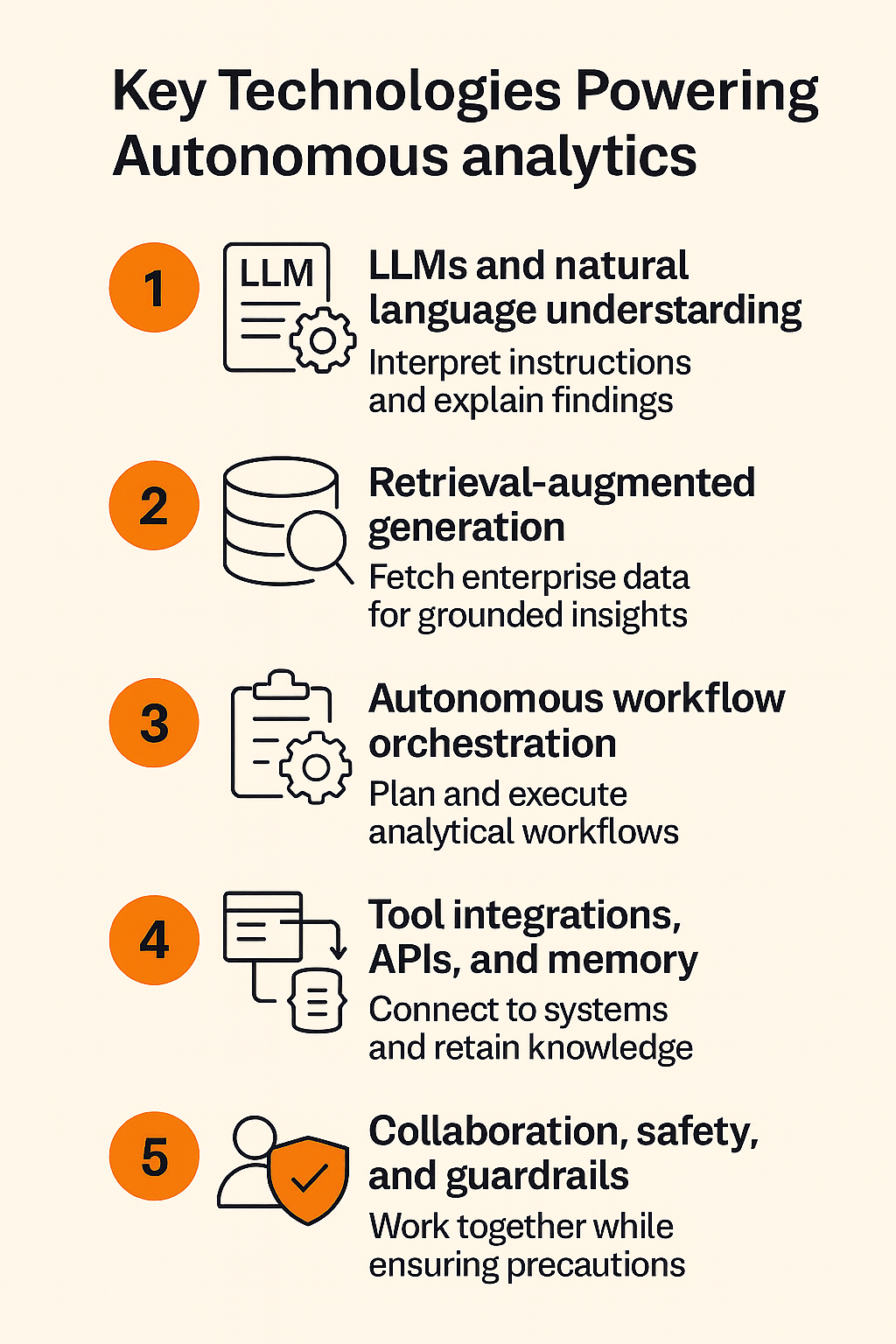
Agentic AI is powered by a suite of advanced technologies working together to enable autonomous analytics and decision-making.
1 LLMs and natural language understanding
Large Language Models (like GPT-class systems) give agents the ability to interpret human instructions, reason through tasks, and explain findings clearly. This makes them behave like “digital analysts” that can both understand and communicate insights naturally.
Also read: Step-by-Step Guide: How Enterprises Can Connect LLMs to Their Data
2 Retrieval-augmented generation (RAG) for grounded insights
RAG allows agents to fetch and reference real data from enterprise sources, ensuring responses are factual and context-aware. By grounding their reasoning in verified company data, RAG-based agents reduce hallucinations and increase trust.
3 Autonomous workflow orchestration
Instead of following a rigid script, agents dynamically plan and execute multi-step analytical workflows — from querying databases to running models and visualizing results. This “chain-of-thought” planning lets them adapt to new data, reroute around issues, and handle complex analytical goals independently.
Also read: Agentic AI Workflows: Beyond Automation, Toward Autonomous
4 Tool integrations, APIs, and memory
Agents can connect to databases, APIs, and business systems to take real actions, from querying data to triggering alerts or updates. Memory and contextual awareness allow them to retain insights, preferences, and historical knowledge for ongoing improvement.
5 Collaboration, safety, and guardrails
In advanced deployments, multiple specialized agents collaborate—one extracts data, another analyzes it, another narrates the findings. They’re orchestrated like a digital operations team.
Real-world applications of agentic data management
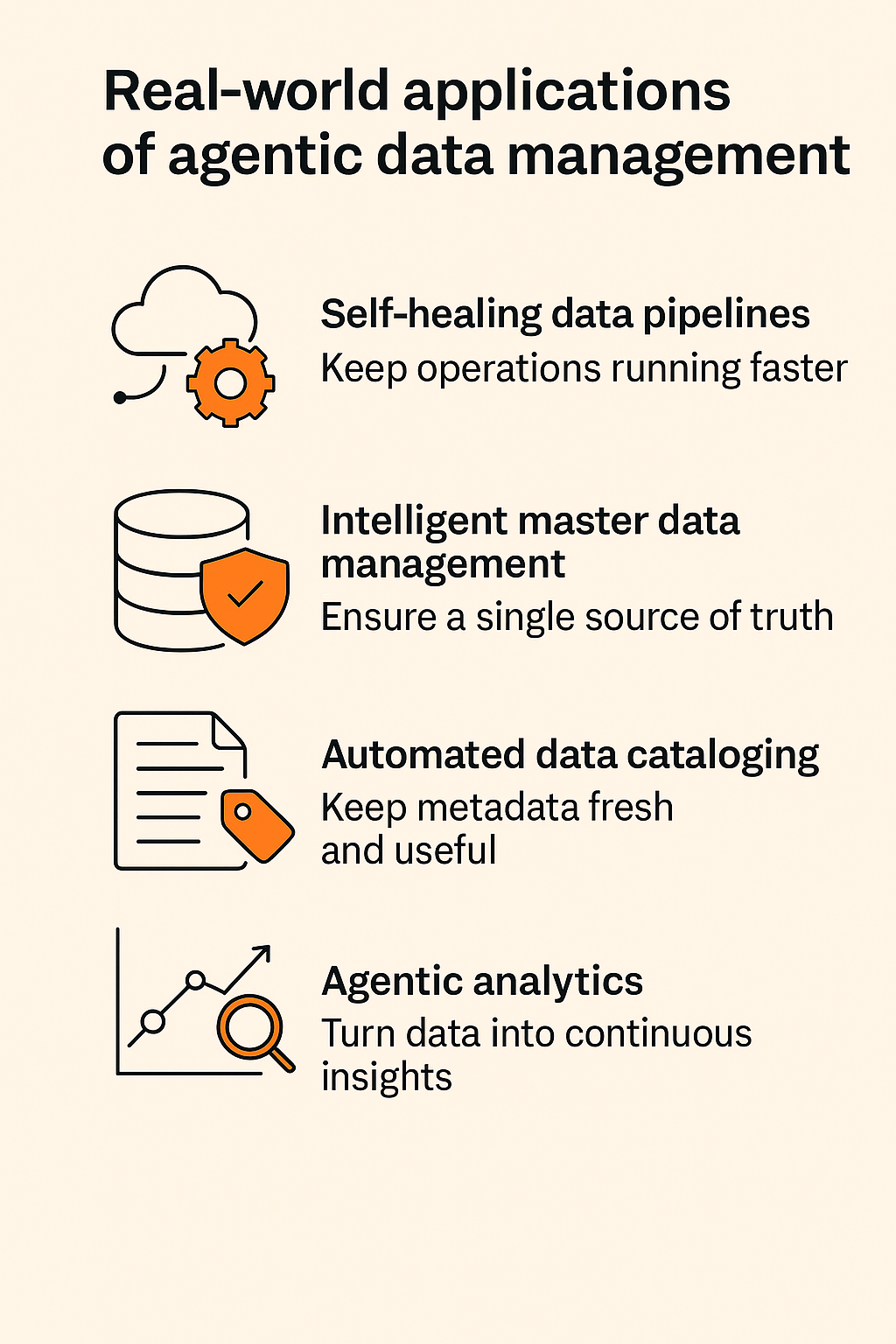
Agentic data management might sound futuristic, but it’s already being applied in various industries and use cases. Here are a few practical examples of how AI agents are autonomously handling data tasks in the real world:
1 Self-healing data pipelines keep operations running faster
AI agents now act as autonomous data engineers, continuously monitoring and repairing pipelines across cloud and on-prem systems. When a data job fails, the agent identifies, debugs, and corrects the issue automatically. Tasks that once took days to resolve now finish in minutes, resulting in faster recovery, less downtime, and fewer human interventions.
2 Intelligent master data management ensures a single source of truth
Agentic MDM solutions maintain consistency across systems. They detect discrepancies, reconcile mismatched records, and update information in real time. This creates a single, reliable source of truth for customer and product data. Unified analytics become easier, and KPIs are more accurate across departments.
3 Automated data cataloging keeps metadata fresh and useful
Many organizations struggle to track their data assets. Agentic cataloging solves this by using AI agents to discover, tag, and classify datasets automatically. They identify sensitive information, assign ownership, and keep catalogs current. Teams can find data faster and maintain stronger governance.
4 Agentic analytics turn data into continuous insights
Once data management becomes autonomous, analytics can follow. AI agents now monitor business metrics, interpret trends, and uncover root causes. If performance drops, the agent pinpoints why and suggests actions. This creates always-on intelligence that turns raw data into real decisions.
5 Continuous data quality monitoring protects accuracy and compliance
Better AI isn't about more data; it is about the quality of data and its connectivity. We have assigned accountability to make sure that we just don't keep on saying the quality is bad, but keep improving it.
~ Anindita Misra, Global Director of Knowledge Activation & Trust, Decathlon Digital
How Decathlon uses data to optimize in-store operations
5 Challenges of agentic data management
While the promise of agentic data management is enticing, implementing it in the real world isn’t without hurdles. It’s important to be aware of the challenges and plan for them, so you can reap ADM’s benefits while minimizing risks. Here are some key challenges and ways to address them:
1 Integrating with legacy systems remains complex
Many organizations have a patchwork of old and new data systems. Plugging AI agents into every corner – from a modern cloud warehouse to a 20-year-old on-prem database – can be tough. Agents need access to all relevant data, but legacy systems might not expose easy APIs or may have brittle processes.
Solution: Build on a unified data platform that can connect across sources (this is where a platform like 5X, which is cloud- and data warehouse-agnostic, helps by bringing all your data under one roof)
2 Building trust and oversight takes time
Handing the reins to AI can be scary. How do you trust an autonomous agent to make the right decisions in managing data? What if it fixes something that isn’t actually broken, or worse, propagates an error across systems? This challenge is both technical and cultural.
Solution: Implement a human-in-the-loop design, at least initially. For example, configure agents to suggest actions (like “I will delete 500 duplicate records in dataset X”) and log their decisions, so a human can review or veto if needed. Over time, as confidence grows, you can increase autonomy.
3 Governance and compliance require tight controls
Ironically, while ADM improves governance, it can also introduce concerns if not properly managed. Autonomous agents that access and move data must be carefully permissioned. There’s a risk of an agent inadvertently exposing sensitive data or violating a compliance rule if it isn’t programmed with those constraints.
Solution: Maintain strict governance around the agents themselves. Treat each AI agent like a service account with only the necessary data permissions. Leverage your data catalog and security framework to enforce policies (e.g. an agent shouldn’t copy personal identifiable info into an unauthorized location).
4 Skill and culture shifts are essential
Shifting to agentic data management requires new skills (understanding AI workflows, prompt engineering for LLM-powered agents, etc.) and a cultural shift in the data team. Data engineers might worry about their roles, and non-technical stakeholders might not understand or trust what the agents are doing.
Solution: Invest in training your team on the new tools and emphasize that agents are there to augment, not replace, humans. Share success stories internally where agents eliminated drudgery and allowed employees to focus on more strategic work.
Also read: Data integration automation: How to eliminate manual ETL and speed up insights
5 Handling edge cases and errors demands vigilance
No AI is perfect. Agents might encounter scenarios they weren’t trained for – an entirely new data format, a bizarre data anomaly, or simply a bug in their code. If everyone assumes “the agent’s got it,” such issues could go unnoticed longer than they should.
Solution: Maintain a feedback loop. Just as agents have feedback mechanisms for learning, set up feedback for your team. If an agent fails or seems stuck, make sure it alerts someone or has a fallback to human operation. Run fire-drills: intentionally introduce a novel scenario and see how the agent copes, then refine its programming.
Make your data run itself, safely
Agentic data management is a practical way to keep data clean, compliant, and ready for analysis. AI agents watch pipelines, fix common issues, and flag what needs attention. Your team spends less time on routine work and more time on decisions that move the business.
Success still depends on the basics. If data is scattered or unclear, results will suffer. Start by unifying sources, assigning clear ownership, and tracking lineage and quality. Add guardrails so access follows least privilege and every change is visible. Begin with one high impact workflow, measure the outcome, and then expand step by step.
5X gives you a strong base for this shift. It is built on open source, works across clouds and warehouses, and comes with hands-on support and a simple licensing model. That means faster setup, fewer surprises, and more control.
FAQs
What is agentic data management?

How is agentic data management different from traditional data management?
What are the benefits of using agentic AI in data management?
Is agentic data management secure and compliant?
What industries can benefit most from agentic data management?
Building a data platform doesn’t have to be hectic. Spending over four months and 20% dev time just to set up your data platform is ridiculous. Make 5X your data partner with faster setups, lower upfront costs, and 0% dev time. Let your data engineering team focus on actioning insights, not building infrastructure ;)
Book a free consultationHere are some next steps you can take:
- Want to see it in action? Request a free demo.
- Want more guidance on using Preset via 5X? Explore our Help Docs.
- Ready to consolidate your data pipeline? Chat with us now.
Get notified when a new article is released
Related articles
%201.svg)
.png)

How retail leaders unlock hidden profits and 10% margins


Retailers are sitting on untapped profit opportunities—through pricing, inventory, and procurement. Find out how to uncover these hidden gains in our free webinar.
Save your spot