Data as a Service: The complete guide to accessing data on-demand in 2026

Table of Contents


TL; DR
- Most data problems are about slow access, stale pipelines, and low trust
- DaaS) delivers data on demand, just like cloud software or infrastructure.
- Instead of copying data into tools, teams access live, governed data
- DaaS removes the need to own or manage complex data infrastructure and ETL pipelines
- DaaS reduces time-to-insight from by keeping data fresh and consistent
- Security and compliance are enforced centrally with built-in access controls and audit trails
- Performance is optimized through standardized processing
- Real-world use cases span supply chains, banking, personalization, and real-time decision
- When used responsibly, DaaS turns data from a cost center into a scalable growth lever
Most teams don’t struggle because the data they have is locked inside data platforms, warehouses, CSVs, and tools that take weeks to update and even longer to trust. By the time the numbers show up, the moment has already passed. Data as a Service (DaaS) solves this problem.
Instead of copying data into systems and hoping it stays fresh, using DaaS empowers your team to access live business intelligence data on demand. Without having to “own” your data stack anymore, you can use your data when and where you need it.
Read this guide to understand DaaS and how you can access data on-demand in 2026.
What is data as a service (DaaS)?
Data as a Service (DaaS) is a way of delivering data the same way cloud providers deliver software or infrastructure. This means that data is delivered on demand, via APIs, and without forcing teams to worry about where the data lives or how it’s maintained.
Instead of copying datasets into warehouses, spreadsheets, or tools, DaaS lets users access live, trusted data when they need it. The provider handles ingestion, updates, quality, governance, and scalability. Consumers just query or plug the data directly into analytics tools or AI models.
Think of it like this. You don’t download Google Maps to your laptop every day. You call it when you need directions. DaaS works the same way for business data. For example:
- A sales team pulls enriched lead data via API instead of managing CSVs
- A product team queries customer behavior data without rebuilding pipelines
- An AI model consumes continuously refreshed datasets without manual prep
The value of DaaS is speed and reliability. Teams stop fighting over stale exports, broken pipelines, or “whose data is correct.” In short, DaaS turns data from a static asset into a real-time utility.
Why does your business need data as a service (DaaS)?
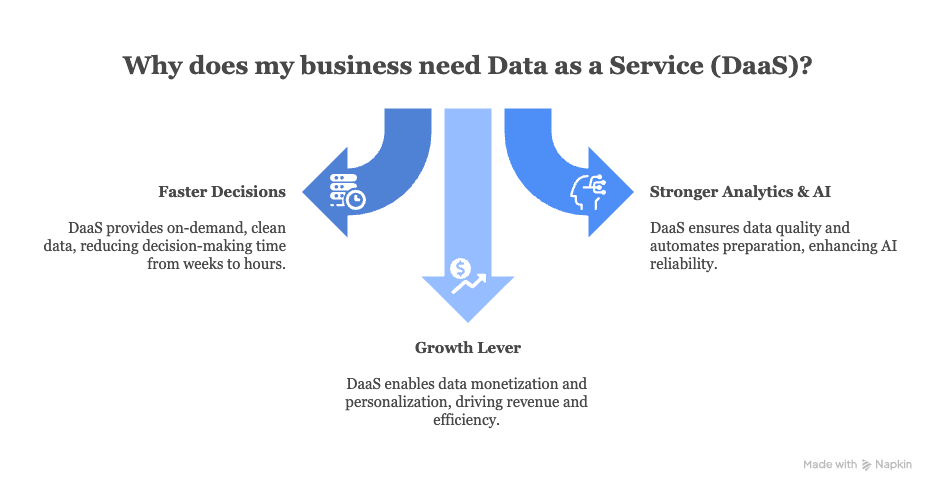
With DaaS, teams stop moving data around and start accessing it directly. Sales gets fresh enrichment data without CSVs. Product teams query live behavioral data instead of rebuilding pipelines. AI models train on continuously updated datasets instead of stale snapshots.
Here’s an overview of why your business needs DaaS:
1. Faster, better data-driven decisions
Most organizations struggle with data access, freshness, and usability. Data as a Service removes the friction that slows decisions by making clean, analysis-ready data available on demand.
Instead of building custom ETL pipelines every time a team needs insight, DaaS pulls together customer data, third-party signals, and real-time operational metrics into a unified view. Teams get what they need without waiting weeks for engineering support. In competitive markets, that speed matters. Decisions made hours earlier can directly impact revenue, growth, and market position.
Companies using DaaS consistently shrink time-to-insight from weeks to hours. Because new data sources are added automatically and historical data stays consistent, leaders stop relying on outdated snapshots and start acting on what’s happening now.
2. A stronger foundation for analytics and AI
AI fails because of bad data. DaaS solves this by delivering clean, structured, and continuously updated data that’s ready for analytics and machine learning.
Data preparation tasks like cleaning, schema alignment, and feature readiness usually eat up most of a data science team’s time. DaaS automates this work, allowing teams to focus on building models and driving business outcomes instead of wrestling with pipelines.
Modern DaaS platforms also monitor data quality, detect drift, and flag issues before they break dashboards or models. This keeps analytics and AI systems reliable in production.
3. Turning data into a growth lever
DaaS doesn’t just support internal teams. It helps organizations unlock real business value from their data. Some monetize it directly by packaging insights as data products. Others use it to personalize customer experiences, improve retention, and reduce operational waste.
When teams trust and access the same data, optimization becomes easier. Businesses routinely see measurable efficiency gains across sales, operations, and customer success. The result is simple: data stops being a cost center and starts acting like a revenue driver.
How does data as a service work?
Data as a Service works by separating data access from data infrastructure. Instead of building and maintaining complex systems, businesses consume clean, governed data on demand.
Here’s a step by step breakdown of how data as a service works:
Step 1: Data is pulled from multiple sources
A DaaS platform connects to a wide range of sources such as operational databases, cloud apps, data lakes, warehouses, third-party providers, and real-time streams.
Unlike traditional ETL jobs that run once a day (or worse, once a week), modern DaaS platforms ingest changes as they happen. That means when something changes in production, sales, usage, or customer behavior, the data updates almost instantly, not hours or days later.
Step 2: Data is standardized and validated
All incoming data passes through a virtual data layer. This layer ensures that no matter where data comes from, consumers see one consistent, trustworthy version. When data is standardized, it:
- Harmonizes schemas
- Fixes inconsistencies
- Validates data quality
- Applies business rules
Step 3: Security, privacy, and compliance are enforced
Before data is shared, DaaS platforms enforce access controls, privacy rules, and consent policies.
Who can see what?
Which fields are masked?
Is this dataset compliant with GDPR or CCPA?
All of that is handled centrally, with audit logs and metadata tracked automatically. Teams don’t need to manually “be careful”, the platform enforces the rules for them.
Step 4: Data is processed and optimized for speed
Once data is clean and governed, the next problem is performance. Trusted data is useless if it’s slow, breaks under load, or collapses the moment more teams start using it.
This is where DaaS quietly does the heavy lifting.
Behind the scenes, the platform handles transformations, orchestration, caching, and performance optimization automatically. Instead of every team building its own pipelines or rewriting logic for different tools, DaaS standardizes how data is processed and reused.
For example, if multiple teams need customer lifetime value, the platform computes it once, caches it intelligently, and serves the same trusted result everywhere without duplication.
Step 5: Data is delivered where it’s needed
Instead of exporting CSVs, scheduling manual jobs, or waiting on engineering, teams access data through APIs or automated deliveries. Data arrives in the format, frequency, and structure each system expects. This means:
- BI teams pull real-time metrics into dashboards
- A product team feeds fresh usage data into an application
- Sales tools get enriched customer profiles synced automatically
- AI models consume governed, up-to-date features without custom pipelines
Because delivery is standardized, data flows reliably into warehouses, CRMs, SaaS tools, mobile apps, and ML systems without breaking or drifting over time. Data stops being something you “fetch and fix” and becomes something your systems can depend on continuously and at scale.
How is data as a service different from data as a product?
Data as a Service (DaaS) focuses on how data is accessed. It gives teams instant, on-demand access to data through APIs or cloud delivery without worrying about infrastructure, pipelines, or storage.
Here’s how DaaS is different from Data as a product:
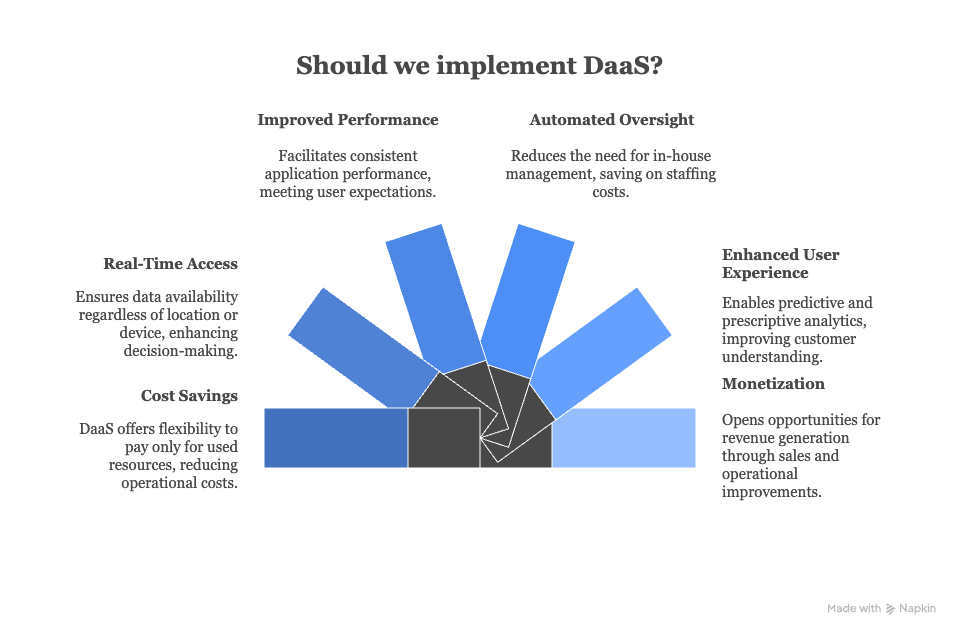
When done right, DaaS turns data into a real business asset, not a technical liability. Here’s an overview of the benefits of using data as a service (DaaS):
- Lower, more predictable costs: DaaS runs on the cloud, which means you pay for what you use, not for peak capacity you might never hit. Analytics-heavy workloads can scale up when needed and scale down just as easily
- Reliable access to real-time data: With DaaS, teams access live data wherever they are, on whatever system they’re using. No dependency on local infrastructure, manual exports, or delayed refresh cycles. Decisions are based on what’s happening now, not yesterday
- Better application performance: When data is always available and consistently delivered, applications stop breaking under load. Dashboards refresh faster, products respond in real time, and critical systems perform the way users expect them to
- Automated management and oversight: Updates, data quality checks, troubleshooting, and maintenance are handled by the DaaS provider. Internal teams spend less time babysitting pipelines and more time building value. In many cases, this reduces operational roles
- Stronger end-user experiences: Because DaaS supports advanced analytics, businesses gain deeper insight into customers, partners, and internal users. Predictive and prescriptive analytics become easier to deploy, leading to smarter decisions and personalized experiences
- New monetization opportunities: DaaS doesn’t just save money—it can make money. Organizations can package insights as data products, share data with partners, or unlock revenue indirectly through better operations and customer satisfaction. Data stops being passive and starts paying for itself.
Data as a service use cases
The best way to illustrate how DaaS can benefit modern enterprises is to look at organizations that have used such platforms to turn their data into one of their most valuable assets.
1. BMW develops total supply-chain visibility
Maintaining a smooth-running supply chain is integral to any manufacturer, but especially one in the hypercompetitive automotive industry. BMW Group needs to move 30 million parts per day to maintain its production schedule, and those components come from all over the world by rail, road, air, and sea. Critical data is generated at each link in the supply chain.
BMW uses DaaS in the form of a robust data analytics platform, which allows the automaker to access and analyze key details regarding suppliers, pricing, production, shipping, and more. The visibility granted by DaaS lets supply analysts monitor production in real time, and when problems arise, they’re seen more quickly so they can be mitigated.
2. Royal Bank of Canada gains greater customer insight
Though it is one of North America’s largest banks with approximately 17 million clients across 36 countries, Royal Bank of Canada (RBC) knew it needed to distinguish itself in the marketplace by offering exceptional customer experiences. Meticulous analysis of client data would be necessary.
RBC used DaaS and analytics tools to scale data science projects across the organization and automate various data management tasks, which helped improve decision-making and generate insights at scale to form detailed profiles of customers. The bank built an ML-driven recommendation engine for commercial account managers to derive client-relevant information.
3. Groupon empowers customers and partners with data
Groupon relies just as much on its partner merchants as it does the consumers who use its mobile app or website for discounts. And without the ability to make data actionable, customers won’t see intriguing deals, and merchants have no incentive to provide those deals.
The organization originally stored data on-premises. This became cost-inefficient as sudden market changes forced it to increase storage or compute power by buying additional hardware and infrastructure. By migrating to the cloud and adopting various DaaS tools, Groupon enabled itself to scale more easily in tune with demand, while cutting-edge analytics ensured customers encountered the most relevant deals and merchants got potential repeat customers.
What are the potential risks of data as a service (DaaS)?
Data as a Service removes a lot of operational friction, but it also shifts responsibility. When your data lives outside your walls, the margin for error gets smaller.
- The biggest risk is data exposure. You’re sharing sensitive business and customer information with external platforms. If access controls are weak or security practices aren’t airtight, a breach doesn’t just leak data, it damages trust and reputation
- Compliance risk is another quiet problem. Regulations like GDPR and CCPA don’t disappear because a third party is handling your data. If your DaaS provider falls short on consent management, data residency, or audit trails, your organization still pays the price
- There’s also the risk of vendor dependency. Over-relying on a single provider can limit flexibility, slow innovation, or create operational disruption if the service goes down or pricing changes unexpectedly
The fix is using DaaS responsibly. Strong security controls, regular audits, clear SLAs, and strict access policies are non-negotiable. Pair that with employee training and least-privilege access, and DaaS becomes a controlled advantage, not a blind risk.
FAQs
What is an example of DaaS?

What are the different types of DaaS?
Is DaaS cloud computing?
Building a data platform doesn’t have to be hectic. Spending over four months and 20% dev time just to set up your data platform is ridiculous. Make 5X your data partner with faster setups, lower upfront costs, and 0% dev time. Let your data engineering team focus on actioning insights, not building infrastructure ;)
Book a free consultationHere are some next steps you can take:
- Want to see it in action? Request a free demo.
- Want more guidance on using Preset via 5X? Explore our Help Docs.
- Ready to consolidate your data pipeline? Chat with us now.
Related articles
%201.svg)
.png)
.png)

How retail leaders unlock hidden profits and 10% margins


Retailers are sitting on untapped profit opportunities—through pricing, inventory, and procurement. Find out how to uncover these hidden gains in our free webinar.
Save your spot