How to build and improve data trust: Eight working strategies that move the needle
.png)
.png)
Table of Contents


TL; DR
- Data trust is the foundation of every analytics, AI, and decision-making process
- Without trust, teams ignore dashboards and fall back on intuition and spreadsheets
- Data trust = accuracy + consistency + transparency + security + governance
- Freshness checks and clear metric definitions are the fastest trust wins
- Visible data lineage instantly increases confidence in dashboards and reports
- Proactive quality checks catch issues before they hit leadership
- Reusable workflows stop metric drift and conflicting dashboards
- Practical governance (not bureaucracy) drives adoption across teams
- Cultural habits (transparency, documentation, ownership) make trust sustainable
Everyone talks about “data-driven decisions,” but none of it works if people don’t actually trust the data. You can have the best warehouse, the cleanest dashboards, the fanciest AI models, but if your team secretly thinks the numbers are off, the whole system collapses.
Bad data doesn’t just break dashboards, it breaks trust. And once trust breaks, everything slows down. People go back to gut decisions, offline spreadsheets, Slack messages like “Hey, is this the right metric?”, and endless arguments about which version of the truth to believe.
That’s exactly why data trust is so crucial. Read this guide to explore what data trust means, why it matters, and the eight strategies you can implement to boost trust.
What is data trust, and why is it important for your organization?
Data trust is your organization’s confidence that the data you’re using is accurate, consistent, and safe to act on. It’s the belief that your numbers won’t betray you. It ensures that dashboards won’t contradict each other, that teams aren’t fighting over “whose report is right,” and that your data won’t suddenly break right before an important decision.
Data trust is important for your organization because it acts as the foundation of every digital initiative including your data analytics, automation, AI, customer experience, and forecasting.
High-trust in your data is crucial because it reduces risks like compliance issues and broken customer experiences. Moreover, when people inside your company don’t trust the data, they stop using it, which means that they go back to relying on intuition, manual workarounds, and stale spreadsheets, which results in less productivity and slower decisions.
Key components of data trust and why it matters
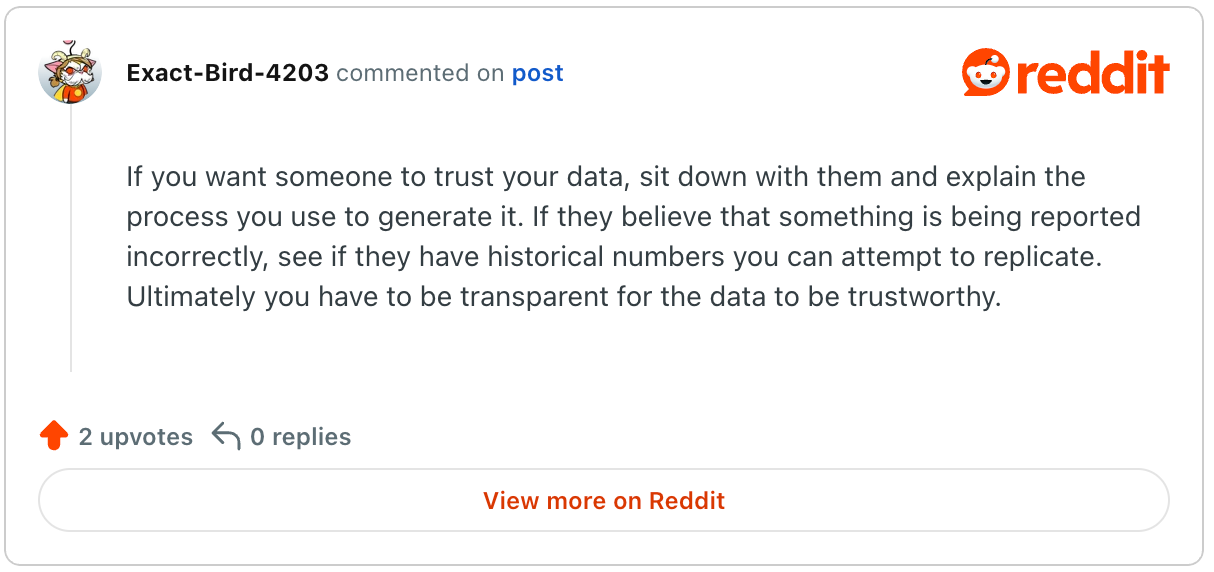
Data trust is built on the sum of several things you consistently get right. According to users on Reddit, transparency is pivotal to creating data trust.
Here are other components that dictate if your stakeholders will trust your data:
- Transparency: Starting with the first component, it is a no brainer that people trust what they understand. Being open about how data is collected, used, and shared builds confidence internally and externally. For example, a company publicly reporting a minor data incident and the steps taken to fix it earns more trust than one that hides it for months
- Data quality: This is the foundation. If your data isn’t accurate, complete, or consistent, everything that comes after it falls apart. Think of a revenue dashboard that shows ₹50 Cr for sales while finance reports ₹46 Cr. One discrepancy, and suddenly everyone stops trusting the system. High-quality data eliminates second-guessing and keeps decisions sharp
- Data security: People won’t trust data if they don’t feel it’s safe. Security means preventing unauthorized access, leaks, and breaches especially when you’re storing PII, financials, or customer behaviour data. For example, a misconfigured S3 bucket exposing customer records can destroy years of brand trust overnight
- Data governance: Governance is the rulebook. It ensures your data is classified correctly, stored the right way, and accessible to the right people. Strong governance prevents issues like two teams using different definitions for “active user”, outdated spreadsheets circulating as “the truth”, or sensitive data showing up in the wrong dashboards
- Compliance: Regulations like GDPR, HIPAA, and CCPA are baseline. Staying compliant protects you legally and sends a strong message that you take data protection seriously. Non-compliance can cost millions, but more importantly, it can cost reputation
- Ethical data use: Ethics matter, especially when your data includes personal or sensitive information. Customers expect companies to use their data responsibly, not stretch permissions or run shady models in the background. Think of the backlash when apps track more than users knowingly shared. Ethical behavior directly drives trust
- User experience: Even the cleanest and safest data won’t be trusted if the tools feel clunky. If employees struggle to find data or don’t understand dashboards, they’ll fall back on gut instinct or their own spreadsheets. A simple, intuitive interface makes data feel accessible — and therefore trustworthy
Quantifying data trust in five simple steps
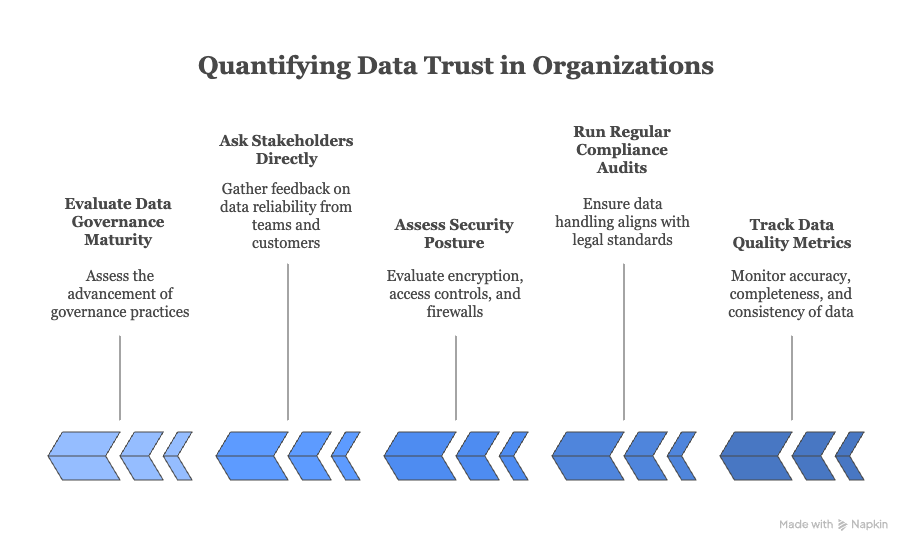
Measuring data trust is the only way to know whether your teams can actually rely on the data they use every day. You can measure trust using the right approach.
Here are five simple and straightforward ways to quantify data trust in your organization.
1. Track your data quality metrics
Start with asking questions like:
Is your data accurate? Complete? Fresh? Consistent?
These quality checks are the closest thing to a heartbeat monitor for your data. If accuracy and completeness are high, you can trust what you’re using. Many teams now automate these checks to generate a data trust score so they always have a real-time understanding of their data.
2. Run regular compliance audits
If you operate in regulated environments, audits aren’t just paperwork. They’re proof that your data handling is actually aligned with legal standards. Passing audits consistently is one of the strongest signals that your data is governed well and can be trusted inside and outside the business.
3. Assess your security posture
Security assessments, pen tests, and vulnerability scans reveal how exposed your data really is. Strong encryption, tight access controls, and well-configured firewalls show that your sensitive data is protected. When your security foundation is solid, trust naturally follows.
4. Ask stakeholders directly
Data trust isn’t only about systems and checks, it’s also about perception. If your teams, customers, or partners don’t feel the data is reliable, they simply won’t rely on it.
Regular surveys and answering critical questions that reveal where hesitation or distrust still exists can help you understand this human layer. Begin by asking questions like:
Do teams trust the dashboards?
Do customers feel confident in how their data is used?
5. Evaluate your data governance maturity
Data maturity models help you understand how advanced your governance practices are. Higher maturity = stronger trust. It’s a structured way to diagnose gaps and measure progress over time.
7 Key benefits of building a culture of data trust
Data trust is what turns raw information into usable, action-driving insights. Once your organization trusts its data, decision-making and AI readiness becomes easier, faster, and far more scalable.
Here are the seven biggest benefits organizations see when they build a strong culture of data trust.
- Faster, more confident decision-making: When teams trust the data, they stop wasting time verifying numbers. Instead of asking, “Is this right?”, they can immediately ask, “What should we do next?” This cuts delays, accelerates decision cycles, and gives leadership real confidence in the insights they’re acting on.
- Higher adoption of BI, analytics, and AI tools: Analytics investments only work when people use them. A trusted data foundation removes skepticism so teams can rely on dashboards, models, and AI-driven recommendations because they know the numbers won’t fail them
- Better cross-team alignment means more clarity and fewer debates: When definitions, metrics, and lineage are standardized, everyone finally speaks the same language. No more “Sales says one number, Finance says another.” This means that a culture of trust can now replace internal debates with aligned action
- Stronger governance and easier compliance: Trust grows when governance is not a burden but a habit of clear ownership, access controls, audit trails, quality checks, and documentation. This naturally strengthens your compliance posture and reduces last-minute panic during audits or regulatory updates
- Reduced business and operational risk: A culture built on trust catches issues early, reduces forecasting errors, prevents faulty reporting, and lowers the risk of costly mistakes. Leaders feel safer making big bets when the data behind those bets is reliable
- More efficiency means less time spent fixing issues: Without trust, teams waste hours validating reports or manually cleaning data. With trust, those hours vanish. Pipelines run smoothly, reports are consistent, and people focus on strategy instead of troubleshooting
- A stronger foundation for AI and advanced analytics: AI models fall apart without trustworthy data. Quality, lineage, transparency, and governance give AI the reliable inputs it needs. Building data trust today means your organization can confidently adopt AI tomorrow without the risk of biased, incomplete, or incorrect outputs
Eight easy steps for creating data trust in your organization
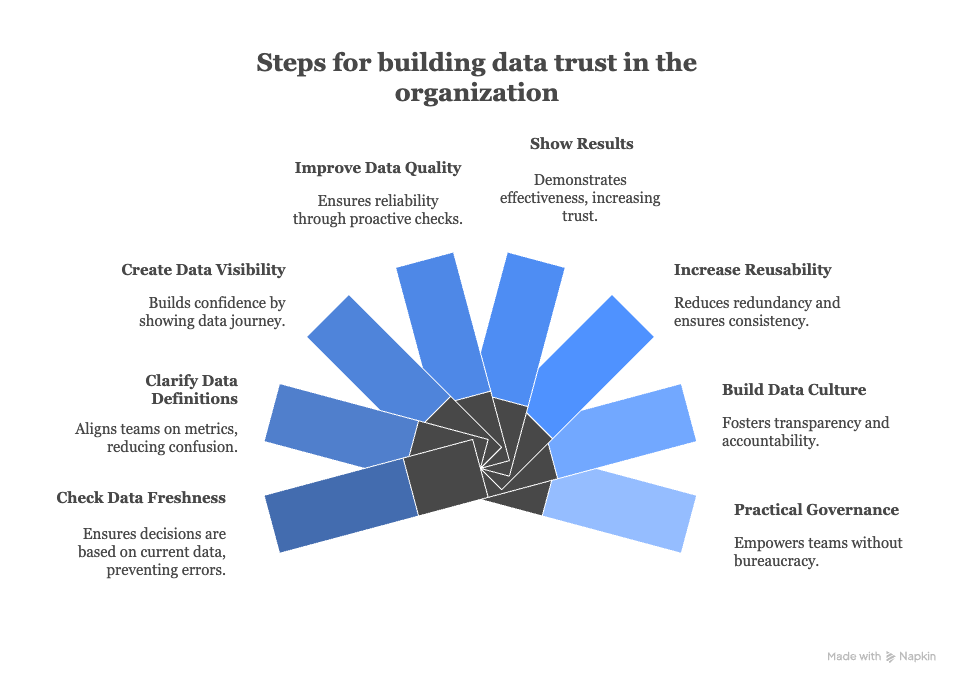
Now that you understand data trust and its importance, here are the five steps you can use to create an environment where teams actively use and trust their data:
- Start with checking data freshness: Before diving into a dashboard, look at the “last refreshed” timestamp. If a dashboard was last updated 36 hours ago, you shouldn’t be using it to decide today’s ad budget. This tiny habit alone prevents a ton of bad decisions
- Make your data definitions crystal clear: Data trust falls apart the moment two teams define the same metric differently. Start by aligning on business definitions, ownership, and usage rules. A shared glossary or data catalog gives everyone the same reference point, so there’s no confusion about what “active user,” “revenue,” or “churn” actually means
- Create visibility into where data comes from: People trust what they can trace. Document data lineage, track how data is transformed, and make pipelines transparent. When teams can see the full journey from source to transformations and dashboards, they’re far more confident in using the data, and far quicker at spotting issues when something breaks
- Improve data quality with proactive checks: Trust doesn’t come from proving your data is clean. Set up automated validations, anomaly detection, and quality SLAs. If a dataset is missing fields, drifting, or violating rules, teams should know instantly
- Show results as it’s the fastest way to build believers: Trust grows when teams see that data-backed decisions work. For example, if your churn prediction model helps retain 20 customers in a month, showcase it. When people see wins, skepticism drops
- Increase reusability with standard workflows: Nothing reduces trust like five teams recreating the same logic in five different ways. Build a library of reusable queries, models, and workflows. If every revenue dashboard uses the same certified logic, no one debates the numbers anymore, they debate the strategy instead and come to a solution quicker
- Build a culture that treats data like a shared product: Data trust is cultural. Encourage transparency, document decisions, celebrate good data practices, and make data owners accountable. When everyone understands the value of reliable data and the cost of poor data, trust becomes part of how the organization operates, not an afterthought
- Make governance practical, not bureaucratic: Governance should empower people, not slow them down. Put the right guardrails in place such as access controls, certifications, and stewardship roles, but keep the workflows simple. When governance feels like support (not red tape), teams naturally adopt it and trust rises
FAQs
What is an example of a data trust?

How to improve data reliability?
Why is it important to build data trust?
Building a data platform doesn’t have to be hectic. Spending over four months and 20% dev time just to set up your data platform is ridiculous. Make 5X your data partner with faster setups, lower upfront costs, and 0% dev time. Let your data engineering team focus on actioning insights, not building infrastructure ;)
Book a free consultationHere are some next steps you can take:
- Want to see it in action? Request a free demo.
- Want more guidance on using Preset via 5X? Explore our Help Docs.
- Ready to consolidate your data pipeline? Chat with us now.
Related articles
%201.svg)
.png)

How retail leaders unlock hidden profits and 10% margins


Retailers are sitting on untapped profit opportunities—through pricing, inventory, and procurement. Find out how to uncover these hidden gains in our free webinar.
Save your spot