The complete guide to identifying and eliminating data silos in 2026


Table of Contents


TL; DR
- Data silos = isolated pockets of data hidden inside tools, teams, or spreadsheets
- They break alignment by giving every department a different version of the truth
- Silos slow decision-making and create inconsistent, incomplete, unreliable data
- They quietly increase costs through duplicate tools, manual work, and shadow IT
- Customer experience suffers when teams can’t see a unified customer journey
- Silos make organizations more vulnerable to breaches and ransomware
- You can identify silos through inconsistent metrics and access issues
- Eliminating silos requires centralizing data, integrating systems, and standardizing metrics
- Practical governance + self-service access prevents new silos from forming
- Removing silos accelerates analytics, improves collaboration and strengthens security
If you’re tired of losing customers and repeatedly making the wrong business decisions based on an outdated number, it’s high time to inspect and fix your data leaks.
Data silos are the leaks that threaten your organization’s data reliability. When you fix these leaks, your entire organization moves faster and smarter with more efficiency.
Read this guide to understand, spot, and eliminate data silos.
What are data silos?
Data silos are pockets of data that live in isolation, usually trapped inside individual tools, teams, or systems that don’t talk to each other. Think of sales, support, and marketing, each having their own version of “the truth,” with no shared visibility.
The problem is that when data sits in silos, it becomes inconsistent, incomplete, and nearly impossible to use for company-wide decision-making. Insights slow down, reporting becomes messy, and teams argue over whose numbers are correct. Data silos disconnect people, processes, and decisions and that kills efficiency, alignment, and customer experience.
Modern platforms like 5X prevent silos by unifying data ingestion, transformation, modeling, and activation in a single environment so teams don’t create isolated data ecosystems.
How do you identify data silos in your organization?
Before you can break data silos, you have to actually spot them, and that’s harder than it sounds. Most teams operate like mini-companies inside the company, each with its own tools, processes, and quiet little spreadsheets no one else knows exist, meaning silos stay invisible until they hurt you.
Here are the signals that usually mean a silo is hiding somewhere:
- Teams complaining they “don’t have the data” for basic initiatives
- No single dashboard that shows a clean, big-picture view of the business
- Different departments reporting different numbers for the same metric
- No one can confidently tell you which version of a metric is “the real one”
- People spending hours just trying to access the data they need
It’s not glamorous, but the easiest starting point is asking IT for a list of every system your company uses, who owns it, and what data lives inside it. That alone exposes some ugly truths.
What are the hidden financial costs of data silos?
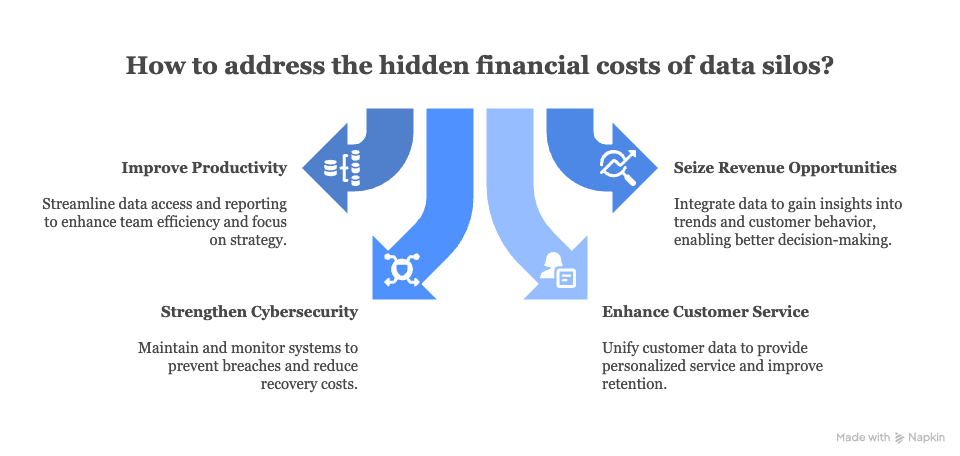
The obvious costs of data silos include extra storage, extra tools, extra licenses. But the real damage isn’t in what you see on invoices. It’s in the hidden financial leaks that slowly drain your business without anyone noticing. Here are the silent profit-killers most teams don’t connect to siloed data:
1. Productivity that quietly collapses
When data lives in disconnected corners, teams end up building workarounds, duplicating reports, and manually merging spreadsheets. They often ask five people for “the latest file.”
This constant patchwork kills efficiency.
Teams stop focusing on strategy and start spending entire days cleaning, fixing, or hunting for data. Multiply that across departments and the cost is huge but invisible.
2. Missed revenue opportunities hiding in plain sight
You can’t act on what you can’t see. When data is trapped in silos, you lose visibility into trends, bottlenecks, churn signals, upsell opportunities, and customer behavior patterns.
This results in slow decision-making, delayed optimizations, and revenue left on the table because teams simply didn’t have the full story.
3. Ransomware recovery that hits harder than expected
Silos often turn into “shadow IT” tools and systems nobody maintains, patches, or even monitors.
Cybercriminals love these forgotten endpoints.
One breach or ransomware doesn’t just cost money. It takes systems offline, disrupts operations, damages trust, and forces expensive recovery efforts. All because siloed systems were easier targets.
4. Higher customer service costs (and worse experiences)
When customer data is split between your POS, the mobile app, the CRM, and a dozen spreadsheets, your teams don’t get a real picture of who the customer actually is.
As a result, agents repeat questions and give generic service instead of personalizing according to the pain point of each customer. This results in customers frustration and lower retention, eventually resulting in marketing teams spending a higher cost to acquire new customers.
What are the main problems caused by data silos?
Data silos are a problem because they quietly break the very thing your business depends on: a single, shared view of reality. When every team operates from its own isolated dataset, the entire organization starts moving slower, less confidently, and with far more friction.
Here are the problems caused by data silos:
- Incomplete, unreliable data: When data sits in separate systems, the right people can’t access it, and teams start working with outdated or conflicting numbers. Example: Marketing reports 12,000 active users, product says 9,800, and finance says 10,400. Suddenly, you’re spending more time reconciling than deciding. This lack of visibility leads to poor decisions, inaccurate forecasts, and broken customer experiences
- Your costs quietly shoot up: Data silos force every team to maintain its own systems, tools, and storage. More servers. More licenses. More shadow IT. More manual cleanup. Because everything is managed separately, operational overhead balloons and you pay for the same data multiple times in multiple places
- Collaboration becomes painfully slow: Nothing derails teamwork faster than two departments looking at two different versions of the truth. When teams can’t share or validate data easily, alignment breaks, priorities clash, and cross-functional work stalls. And the customer eventually feels that confusion
- Security and compliance risks multiply: Silos lead to personal spreadsheets, ad-hoc tools, and unmanaged apps. These are outside IT governance, rarely updated, and often misconfigured, making them easy targets for breaches and ransomware. Unused silos are even worse as there’s no patches, no monitoring, and no ownership
Strategies to eliminate data silos
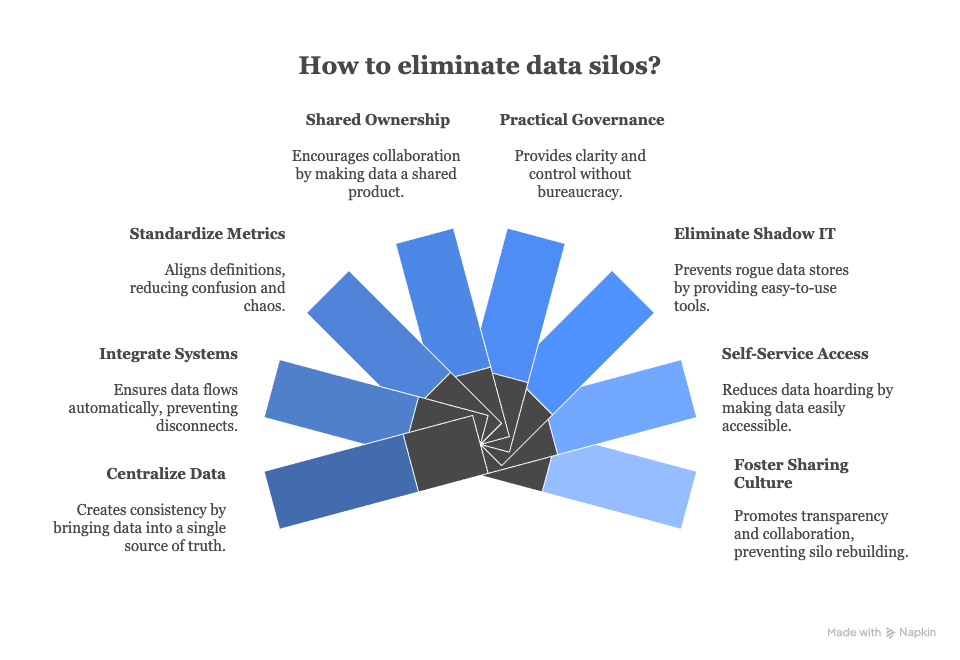
Data silos don’t disappear by installing a tool. They disappear when your systems, teams, and processes stop acting like separate islands. Silos block visibility, break collaboration, inflate costs, and slow down every data initiative you care about. The good news is you can eliminate them using very practical strategies. Here are the ones that consistently work.
1. Centralize your data into a single source of truth
Silos are born when data lives in disconnected systems such as CRM, ERP, marketing tools, support systems, spreadsheets, and “personal files” no one else knows exist. Bringing all of this information into one common warehouse or lakehouse is the only way to create consistency.
Example:
- Marketing tracks MQLs in HubSpot
- Sales tracks leads and accounts in Salesforce
- Support tracks churn reasons in Zendesk
If these live separately, you’ll never know the true customer journey.
Centralizing them lets you create unified models like:
Lead → Opportunity → Customer → Engagement → Renewal Risk
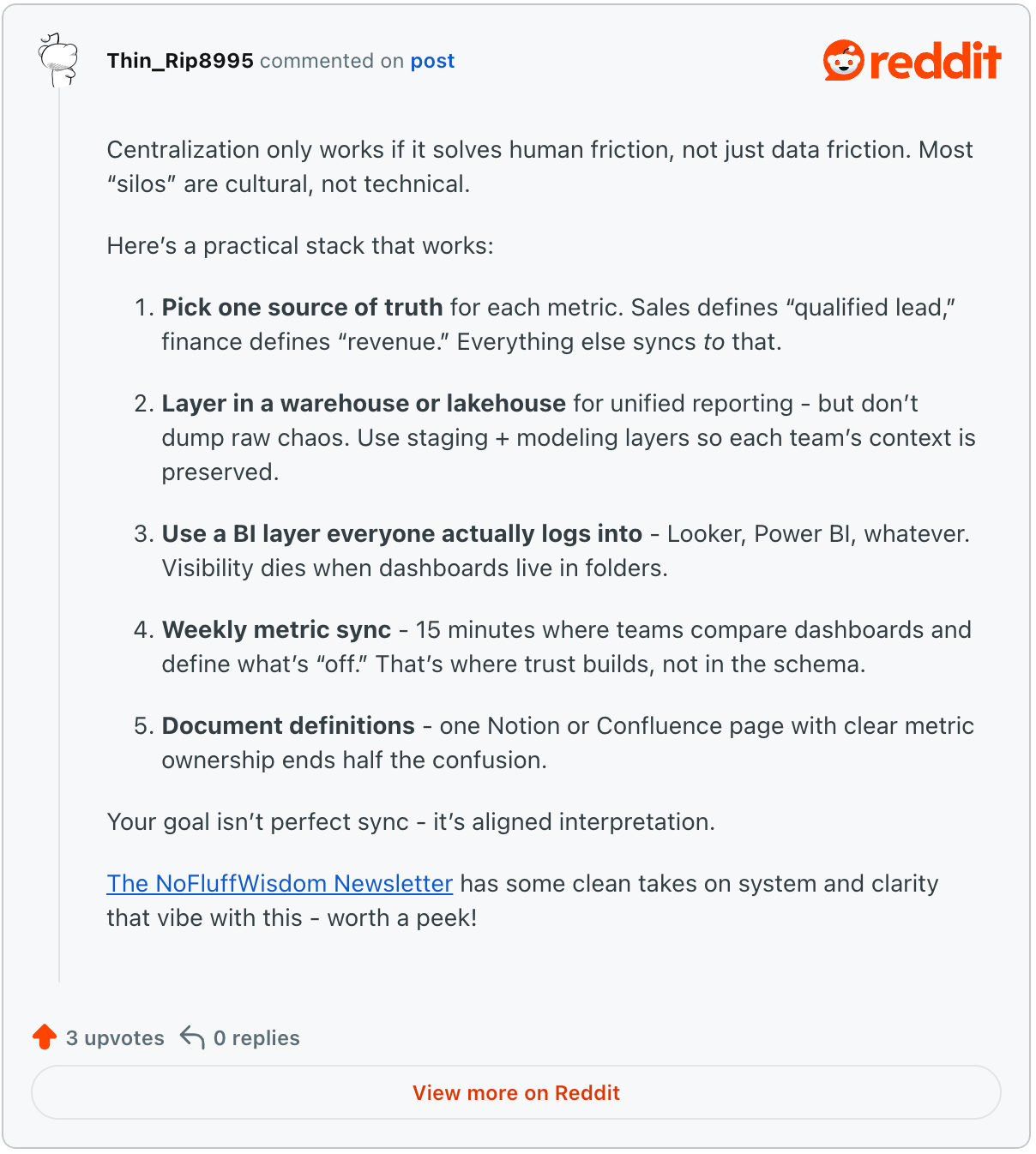
According to users on Reddit, centralization works best if it solves human friction.
2. Integrate your systems so data flows automatically
Silos aren’t always about storage, they’re about systems that don’t talk to each other. Building automated pipelines so data updates everywhere, not just in one tool is one suitable fix.
For example, if a customer upgrades their plan in Stripe but your CRM doesn’t sync automatically:
- Sales won’t know
- Finance will have mismatched numbers
- Support still sees the customer as “on the old plan”
That single disconnect creates three separate “truths” and a classic data silo.
Automation eliminates this instantly.
3. Standardize metrics and definitions (the silent silo killer)
You can destroy silos at the system level and still have definition silos at the human level. When teams define “revenue,” “active user,” or “lead” differently, you guarantee chaos.
Examples include:
- Finance calculates revenue net of discounts
- Sales calculates revenue before discounts
- Product measures “active users” based on logins
- Marketing uses email opens
Teams in the same company operate in different worlds. A shared metric glossary or business catalog aligns everyone and eliminates definition-based silos.
4. Break functional silos with shared ownership
Data becomes siloed because ownership is siloed. When each department runs its own reporting and tooling, you end up with parallel data universes.
Shift to shared ownership with cross-functional governance groups to turn your organization’s data into a shared product, not departmental property.
Instead of Sales owning Salesforce, Marketing owning HubSpot, and Ops owning Excel sheets, create a Revenue Ops council where all three jointly define metrics, pipelines, and data quality rules.
Doing this will encourage your teams to collaborate around data.
5. Implement practical governance (not bureaucratic governance)
Governance doesn’t eliminate silos unless it’s designed for use, not compliance. After all, implementing frameworks for governance gives you clarity. Effective governance includes:
- Clear ownership
- Access controls
- Lineage
- Documentation
- Certified data sets
- Defined update cadences
For example, if five versions of a “revenue dashboard” exist in Looker and no one knows which one is official, you’ve just created a reporting silo even though the tool is modern.
Certified datasets + steward ownership solve this instantly.
6. Kill shadow IT and rogue spreadsheets
Silos often appear because people get frustrated and create their own private data stores.
Employees often store data in personal drives, unmanaged files, or one-off apps. They may feed their data in personal excel trackers that only they have access to or in Google Sheets only one team maintains. You might even lose key information to departmental Airtable/Notion databases that are maintained by one team when the entire organization depends on another data tool.
Oftentimes, there might be cases of unmanaged exports sitting in someone’s desktop or an independent team that maintains separate analytics tools that are bought without consulting IT.
These become parallel data systems with their own logic, definitions, and errors.
Provide sanctioned, easy tools for reporting, sharing, and analysis to your teams so they can stop creating their own hidden data universes. Because when the official tools are as easy as Excel, people stop building hidden data empires. Alternatives include centrally managed dashboards, self-service analytics, a supported BI tool, and a searchable data catalog.
7. Give people easy, self-service access to trusted data
Data hoarding happens when access is hard.
And if employees can’t find data, they make copies. Those copies become silos.
Make discovery effortless by providing a searchable data catalog, documented datasets, creating clear lineage frameworks and implementing intuitive dashboards that’s governed but easy to access.
For example, a marketing manager shouldn’t have to ask IT for a churn number. If she can instantly search for “customer churn” and access the dataset, she won’t create her own version of the truth.
8. Build a culture that normalizes sharing, not hoarding
Tools fix the pipework. Culture fixes the behavior. In simple words, while technology removes barriers in data silos, only your team’s culture can stop people from rebuilding them.
Here’s what this looks like in real life:
- Teams openly share definitions and logic
- Analysts reuse models instead of rebuilding them
- People document transformation steps
- Data owners are accountable
- Wins from shared data are celebrated
- Transparency becomes default
For example, a retail company replaces its habit of “each category manager maintaining their own sales data” with a shared reporting hub. By doing this, they see positive changes such as:
- Teams forecast together
- Marketing sees what’s selling
- Finance closes books faster
- Merchants plan inventory more accurately
In other words, sharing data becomes a competitive advantage.
FAQ's
What is an example of a data silo?

What is the difference between a data warehouse and data silos?
Are data silos good or bad?
Building a data platform doesn’t have to be hectic. Spending over four months and 20% dev time just to set up your data platform is ridiculous. Make 5X your data partner with faster setups, lower upfront costs, and 0% dev time. Let your data engineering team focus on actioning insights, not building infrastructure ;)
Book a free consultationHere are some next steps you can take:
- Want to see it in action? Request a free demo.
- Want more guidance on using Preset via 5X? Explore our Help Docs.
- Ready to consolidate your data pipeline? Chat with us now.
Related articles
%201.svg)
.png)

How retail leaders unlock hidden profits and 10% margins


Retailers are sitting on untapped profit opportunities—through pricing, inventory, and procurement. Find out how to uncover these hidden gains in our free webinar.
Save your spot